What does a CRO consultant do for a DTC brand, and when do you need one?

A CRO consultant finds where a store loses buyers between the ad click and the checkout, then fixes it with tested changes instead of opinions. For a DTC brand that covers the full conversion layer: pre-sell pages, product and landing pages, offer architecture, subscription flows and the A/B testing program. You need one when ad spend keeps rising and the page does not change.
Key takeaways
- A CRO consultant finds where a store loses buyers between the ad click and the checkout, and fixes it with tested changes instead of opinions.
- The scope is the full conversion layer: listicles and advertorials, PDPs and landing pages, offer architecture, subscription flows and the A/B testing program.
- Each step of the work hands the brand an output: a leak map, a test backlog, a verified winner, a sitewide rollout.
- The clearest signal you need one: ad spend keeps rising while the page it points to stays the same.
- Before hiring, ask to see live pages the consultant built, then ask about the numbers behind any of them.
What is a CRO consultant?
A CRO (conversion rate optimization) consultant owns what happens after the click. They find where a store loses buyers between the ad and the checkout, then fix it with tested changes instead of opinions.
For a DTC brand buying traffic on Meta or TikTok, the page decides whether that spend turns into orders. The consultant's job is to make the same traffic earn more: more buyers, bigger orders, more subscribers.
I'm Hamid Chakir. For the last 7+ years I've done one thing: make DTC stores convert better, across over 200 brands, from seed-stage supplements to category leaders like Physician's Choice.
What does a CRO consultant work on?
The full conversion layer, from the first page an ad lands on to the subscription choice in the buy box. My lane is listicles and advertorials for paid traffic, PDPs and landing pages, offer architecture, subscription flows, and the A/B testing program that ties it together.
| Part of the scope | What it is | What it is built to do |
|---|---|---|
| Listicles | Pre-sell page of numbered reasons | Catch the cold click from a Meta or TikTok ad and warm it into a buyer before the PDP loads |
| Advertorials | Story-first pre-sell page | One reader, one problem, one mechanism, then the product, for cold audiences that ignore ads |
| PDPs and landing pages | Gallery, buy box, offer structure, subscription flow | Where the money changes hands |
| Offer architecture | Bundles, quantity tiers and the choices the buy box presents | Raise order value without losing buyers |
| Subscription flows | How subscribe and save is offered and chosen | Turn first orders into repeat orders |
| A/B testing program | Every change tested against the control | Decide with numbers what ships |
Most of the conversion rate lifts in my results ledger came from testing at the point of sale: the PDPs and landing pages.
Below are three live pages from the proof wall, one per format, live at time of writing. These are pages I built, rebuilt or ran the testing program on.
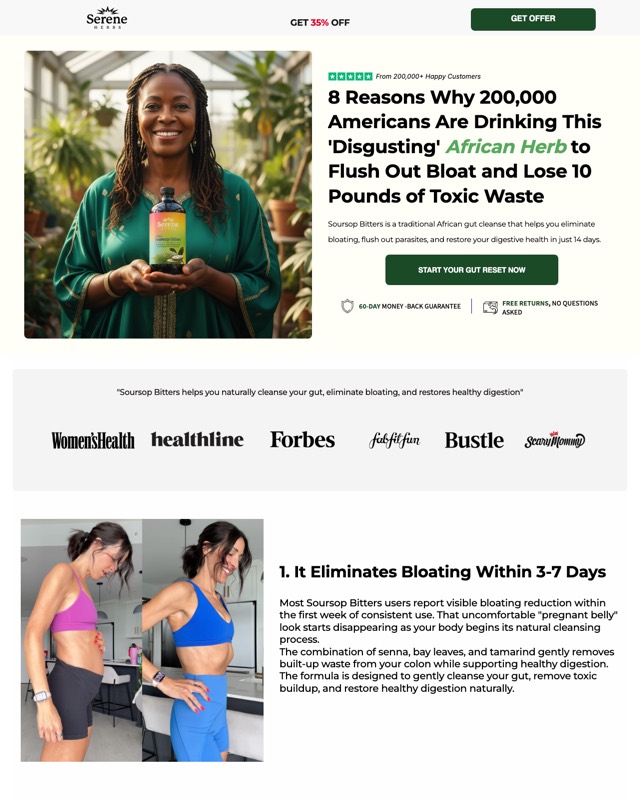
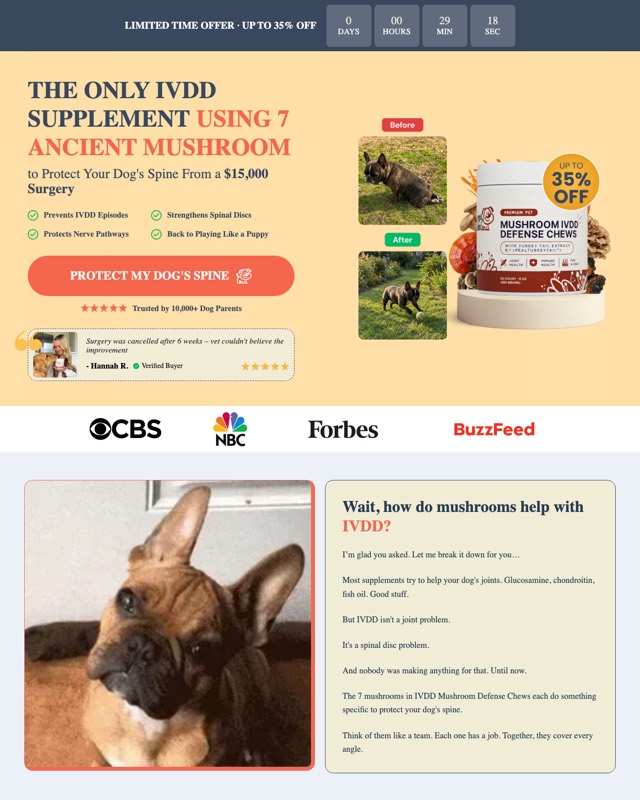
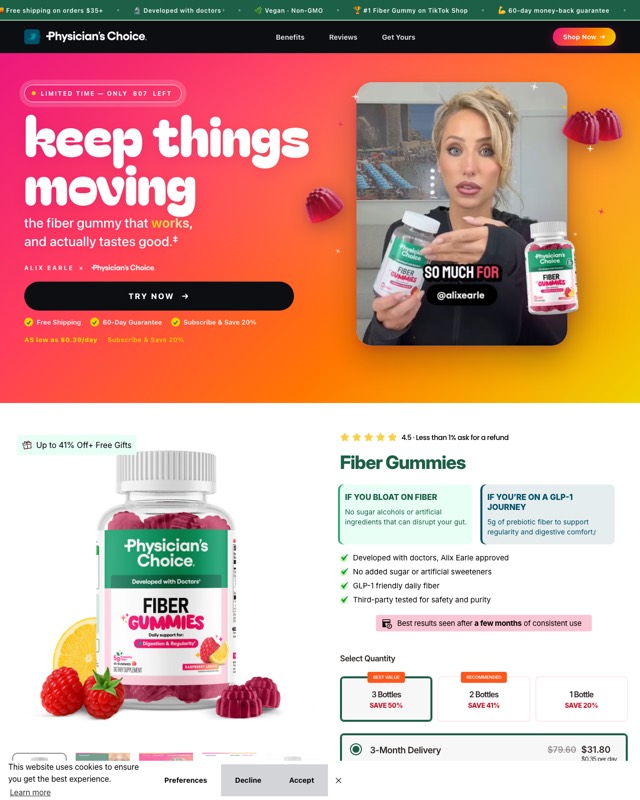
The Serene Herbs listicle opens on a numbered reasons headline beside a photo of a woman holding the bottle, with a star rating line, a button, guarantee and free returns badges, and a press logo bar. The Pets Are Kids Too advertorial pairs a before and after photo set with a customer quote, then moves into a story section that explains the mechanism. The Physician's Choice Fiber Gummies landing page pairs its hero headline with a creator panel showing the product in hand, and puts a buy box with quantity tiers and a delivery plan below it.
What does a brand get from each step of the work?
A concrete output at every step. I run the same four-step loop on every account, and each step hands the brand something it can act on.
| Step | What I do | What the brand gets |
|---|---|---|
| 1. Audit | Analytics, session recordings and funnel data, to find where the money actually leaks | A leak map, ranked by dollars |
| 2. Hypothesize | Rank fixes by expected revenue impact; the biggest leak gets the first test | A test backlog, in priority order |
| 3. Test | A/B test each change against the control | A verified winner, with numbers |
| 4. Scale | Roll winners sitewide and feed learnings into the next round | A sitewide rollout, and the next leak already ranked |
Step five is step one again, so each round ends with a better page and a ranked list for the next one. The full walkthrough is in how a CRO testing program runs.
When does a DTC brand need a CRO consultant?
When the page, more than the ad, has become the limit on growth. These are the signals I look for.
- Ad spend is rising and the page is not changing. Every extra dollar of spend lands on the same page, so a leak on that page grows with the budget.
- Winning ads point to untested pages. The creative team tests hook after hook while the landing page those ads point to has never been tested.
- Opinions decide redesigns. Pages change because someone senior disliked the hero, and nobody can say what the last redesign did to revenue.
- Subscription and order value have never been tested. The subscription offer, bundles and quantity tiers were set at launch and left alone, so nobody knows what they leave on the table.
The work almost always opens with a campaign, while the money is leaking from the page that campaign points to. As I wrote in an essay on LinkedIn, after sixty audited accounts the pattern is almost always the same: the creative is doing its job, and the page is quietly killing the click.
What should you ask a CRO consultant before hiring?
Ask to see live pages, then ask about the numbers behind any of them. It is the same invitation my portfolio makes: scroll the pages, click them, open them on your phone.
- Show me live pages you built. Live URLs you can open on your phone, the way your customers will, rather than mockups or slides.
- What are the numbers behind them? Ask what each page replaced and what it did to conversion rate and order value. For any page on my portfolio, I can tell you why it's built that way, what it replaced, and what it did to the numbers.
- How do you pick what to test first? Listen for a ranking by expected revenue impact, built from an audit of your own data. A list of best practices is a weaker answer.
- How do you decide a winner? Listen for a control, a primary metric chosen before the test, and both conversion rate and revenue per visitor. My checklist is in how to read an A/B test before you ship it.
- Who builds the pages? A winning idea only pays once it ships, working, on the live store. Ask who owns design and development, and how fast a test goes live.
What does working with a CRO consultant look like for the client?
The most useful answer comes from a client. George, CEO and founder of Paid House Agency, recorded a video review with no script and no retakes about the CRO work I did with them across multiple clients.
We were able to build landing pages, product pages. The designs that he oversaw were fantastic from both a visual UI, UX perspective but also from a conversion rate perspective. He also oversaw development as well of all of those pages. Everything was completely functional. We never had a single development hiccup. Everything progressed really quickly for our clients and for our brands ...
George, CEO and founder, Paid House Agency
He also named the numbers the work is judged on:
... his insight into what converts well, what is going to boost AOV, what's going to boost conversion rate, what's going to boost add to cart rate, how can we, you know, increase complete checkout rate.
George, CEO and founder, Paid House Agency
Watch the full review on the portfolio under client review, and read what the work covered in the Paid House Agency case study.
How do you start working with Hamid Chakir?
Tell me what your store converts at today. I'll tell you what I'd test first, before you pay me anything.
Email chakircro@gmail.com with your current conversion rate, and I reply within 24 hours with what I would test first. You can also reach me on LinkedIn.
FAQ
Is a CRO consultant the same as a web designer?
The two overlap on the page, but the jobs differ. A designer makes the page look right. A CRO consultant decides what goes on it, ranks fixes by expected revenue impact and proves each change with an A/B test. On the Paid House Agency work I oversaw both the design and the development of the pages.
Should a CRO consultant work alongside our ad agency?
Yes, and the split is natural: the agency owns the ad, the consultant owns the page the ad points to. Paid House Agency, a boutique agency that works with seven and eight figure e-commerce brands, brought me in on the CRO side for multiple clients, and George describes better performance from paid ads on the brands we worked on.
What does a CRO consultant need from the brand to start?
Access to the data the audit runs on: analytics, session recordings and funnel data. Then the pages paid traffic lands on, the current offer and subscription setup, and a clear answer on who ships changes to the live store. With that, the first output is a leak map ranked by dollars.
Can a CRO consultant guarantee a result?
Nobody can honestly promise a lift before seeing your data. What I commit to is the method: audit where the money leaks, rank fixes by expected revenue impact, test each one against the control and ship only what wins. The results ledger on my portfolio shows what that method has produced on other accounts.
Sources
- Hamid Chakir portfolio: scope, method and results ledger
- Client review video: George, CEO, Paid House Agency
- It Was Never a Bad Agency. It Was a Bad Structure. (Hamid Chakir, LinkedIn essay)
- Serene Herbs: 8 Reasons listicle
- Pets Are Kids Too: IVDD advertorial
- Physician's Choice: Fiber Gummies landing page