Listicle vs advertorial: which pre-sell page should cold Meta and TikTok traffic land on?

Send cold traffic that already accepts the problem to a listicle, and cold traffic that doubts it can be fixed to an advertorial. A listicle gives scannable reasons to choose your product. An advertorial walks one reader through one problem and one mechanism first. Then split-test your pick against the client's control, because the numbers pick the winner.
Key takeaways
- Listicles and advertorials both sit between a Meta or TikTok ad and the product page; they differ in how they handle doubt.
- A listicle stacks numbered reasons with proof beside each one, for readers who accept the problem and are choosing a fix.
- An advertorial earns belief with one story and one mechanism, for skeptical, ad-blind readers who need a new explanation first.
- The formats blend on live pages: Kiwi's advertorial carries a "7 Reasons Why" headline, and a Serene Herbs listicle runs a "Warning" story.
- A rule of thumb picks the first test; the A/B test against the client's control picks the winner.
Should cold Meta and TikTok traffic land on a listicle or an advertorial?
Match the page to what the reader believes when they tap the ad. If they accept the problem and are shopping for a fix, start with a listicle; if they doubt a fix exists, or distrust anything that looks like an ad, start with an advertorial.
Both formats sit in the same place in the funnel: ad, pre-sell page, product page. Neither replaces the PDP. Both exist to warm a cold click before the PDP loads.
The difference is how each one handles doubt. A listicle answers it with many short reasons and proof. An advertorial answers it with one longer explanation the reader can follow.
What is the difference between a listicle and an advertorial?
A listicle is a list of reasons to buy; an advertorial is a story that earns belief in a mechanism before it names the product. The table is built from how I define the two formats on my portfolio and from what the live examples show.
| Dimension | Listicle | Advertorial |
|---|---|---|
| Reader state | Cold click from a Meta or TikTok ad; accepts the problem, open to a new product | Cold and skeptical; ignores ads and may doubt the problem can be fixed |
| Structure | Numbered headline, one reason per block, proof beside each reason | One reader, one problem, one mechanism, then the product |
| Reading pattern | Scanned: the eye jumps between reason headings and images | Read in order: article paragraphs carry the reader from hook to mechanism |
| How it handles skepticism | Stacks proof: ratings, press logos, before and after photos, comparison tables, study cards | Editorial camouflage (masthead, byline, date) plus a mechanism that explains why earlier fixes failed |
| What it hands to the PDP | A reader who has picked the product and wants the offer | A reader who believes the mechanism and sees the product as the answer |
| Best fit | Several clear reasons to switch: work shoes, a one-step skincare routine, fiber gummies | A history of failed fixes or a mechanism to explain: thinning hair, a dog's spine, collagen in menopause |
Read the table as tendencies. On live pages the two formats borrow from each other all the time.
What do the two formats look like on live DTC pages?
Here are two of each from my portfolio proof wall, live at time of writing. The full breakdowns are in listicle landing page examples and advertorial examples.
Listicles: Snibbs and Physician's Choice
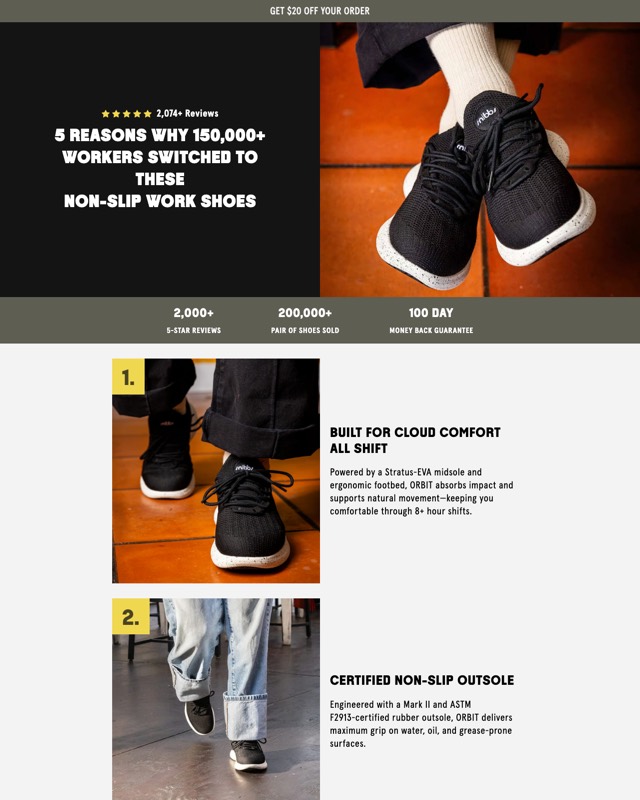
Snibbs leads with a "5 Reasons Why" headline built on how many workers switched to its non-slip work shoes, then a stat band (reviews, pairs sold, a money-back guarantee), then numbered photo blocks. The reader scans claims like "Certified Non-Slip Outsole" and decides.
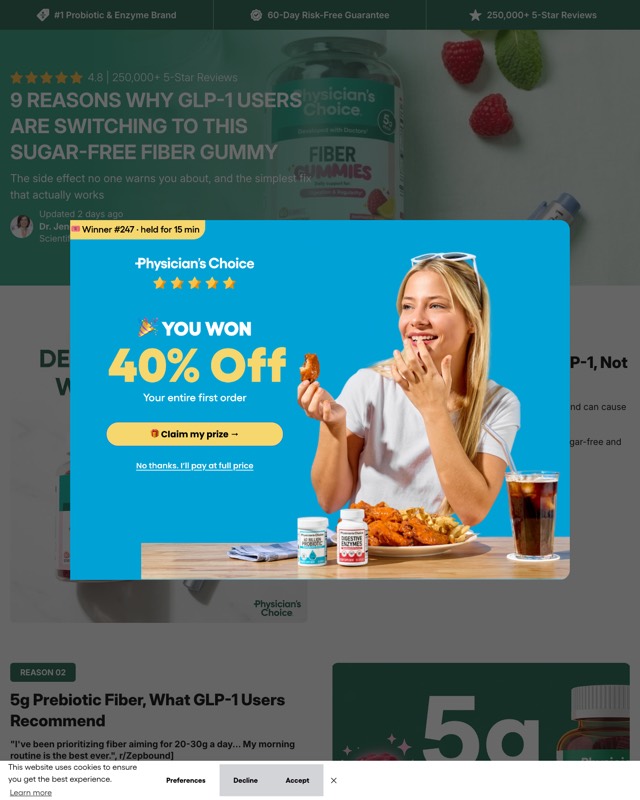
Physician's Choice runs "9 Reasons Why GLP-1 Users Are Switching To This Sugar-Free Fiber Gummy" under a trust bar and a star rating line. Reason 02 backs its claim with a quoted Reddit comment.
Advertorials: Zephta and Quasi

Zephta is labeled "Advertorial", bylined to a doctor and opens with a highlighted question to one reader: "Is your hair feeling thinner, breaking more easily, or just not as full as it used to be?" On the first scroll it explains the dermal papilla.
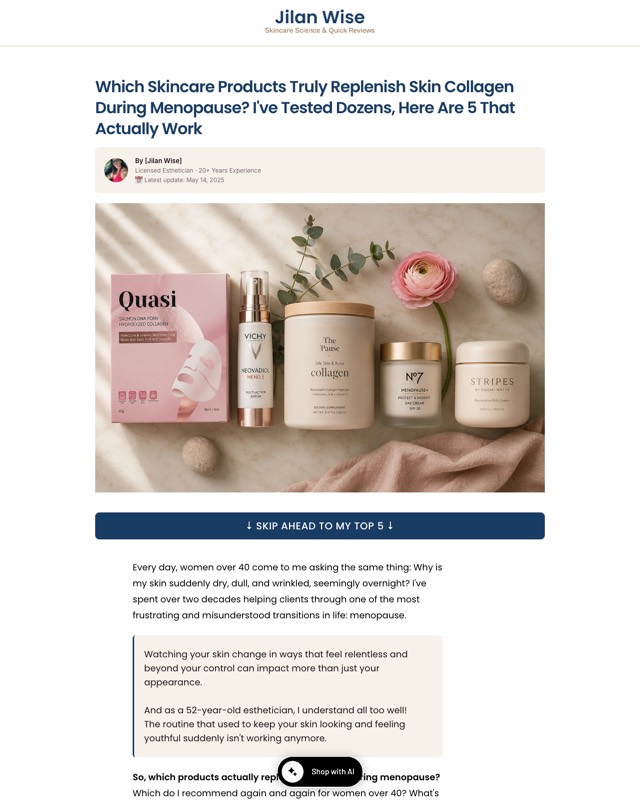
Quasi's page is a review roundup under a skincare-review masthead: an esthetician's answer to which products replenish collagen during menopause, with a "Skip Ahead To My Top 5" button. The product earns its place inside the story.
Where the formats blend
Kiwi's car coating advertorial carries a "7 Reasons Why" headline inside a breadcrumb, byline and news-logo wrapper. The Serene Herbs gut relief listicle opens like a product page, then runs a "Warning" story about a hidden "Bile Drought".
The label describes the dominant move. Real pages mix the tools freely.
How do I decide which pre-sell page to test first?
I use a rule of thumb to choose the first test. It comes from building these pages, and it only picks the starting point: the test result replaces it.
| If the ad and the buyer look like this | Start with |
|---|---|
| The buyer knows the category and wants the better option (fewer steps, non-slip, sugar-free) | Listicle |
| The buyer has tried to fix the problem before and it did not work | Advertorial |
| The product only makes sense once a mechanism is explained | Advertorial |
| You have deep proof assets: reviews, press, before and after photos, comparisons | Listicle |
| The buyer is comparing brands side by side | Comparison listicle, or a review-roundup advertorial |
| The ad tells a story (a founder, an expert, a customer) | Advertorial that continues the story |
| You cannot tell | Build both and test each against the control |
One more rule of thumb: the pre-sell page continues the ad's angle. A reader who tapped a story should land in that story, and a reader who tapped a list of reasons should land on the list.
Why test both formats instead of picking a winner?
Because the winner depends on your traffic, offer and product, and opinions do not ship. Step three of my method is "A/B test against the control. Winners have numbers."
- Audit the current funnel: analytics, session recordings and funnel data, to find where cold traffic leaks between the ad and the checkout.
- Hypothesize: rank the pre-sell ideas by expected revenue impact. The biggest leak gets the first test.
- Test the listicle, the advertorial, or both, against the client's control.
- Scale the winner across the traffic and feed the learnings into the next round.
Serene Herbs shows what a pre-sell program can do at the brand level: a listicle and landing page program plus PDP optimization for paid traffic, with conversion rate up 30% and average order up 20%. That is a program result across pages, and the Serene Herbs case study has the detail.
Step five is step one again: whichever format wins, the next leak is already ranked. The full loop is in my CRO testing process.
FAQ
Can one page be both a listicle and an advertorial?
Yes, and live pages do it often. Kiwi's car coating advertorial uses a "7 Reasons Why" headline inside an editorial wrapper with a breadcrumb, byline and news logos. The Serene Herbs gut relief listicle opens with a product hero, then tells a "Warning" story about a hidden cause. Name the page by its dominant move, then test it.
Which converts better, a listicle or an advertorial?
No format wins for every brand. Reader state, offer and product decide it, which is why each pre-sell page gets split-tested against the client's control. I pick the first test with a rule of thumb; after that, the page with the numbers ships and the other idea goes back into the test backlog.
Does the choice change between Meta and TikTok traffic?
The ad angle and the reader's state matter more than the platform. Both formats are built for the cold click from a Meta or TikTok ad. What changes the choice is whether the ad sold a list of reasons or a story, and whether the viewer already accepts the problem. Match the landing page to the ad first.
Where should a pre-sell page send the reader?
Usually to the product page, where the gallery, buy box, offer structure and subscription flow close the sale. The pre-sell page warms the click and the PDP takes the order, so read pre-sell tests alongside PDP performance. The DTC product page examples show what that point of sale looks like on live stores.
Do I need both formats running at once?
Not at first. Start with the format your rule of thumb favors, test it against the control, and bring in the other format as a challenger once you have a winner. Running both tells you which one fits your cold traffic, which is worth knowing before you scale spend behind either.
Sources
- Hamid Chakir portfolio: format definitions, results ledger and method
- Portfolio proof wall: 39 live pages
- Snibbs work shoe listicle (live page)
- Physician's Choice Fiber Gummies listicle (live page)
- Zephta 2+4 free offer advertorial (live page)
- Quasi collagen advertorial (live page)
- Kiwi car coating advertorial (live page)
- Serene Herbs gut relief listicle (live page)