Advertorial examples: 5 live DTC advertorials, broken down

A good DTC advertorial is a story-first article that sells. It follows one reader, one problem and one mechanism before it names the product, and it borrows editorial cues (a masthead, byline, date and first-person voice) so cold, ad-blind traffic keeps reading to the offer. The five live examples below, from a hair serum to a car coating spray, show that sequence in different wrappers.
Key takeaways
- An advertorial follows one reader, one problem and one mechanism, then the product.
- Editorial camouflage does the holding: mastheads, bylines, dates, breadcrumbs and an "Advertorial" label make the page read as content to people who skip ads.
- The mechanism is the turn in the story: why the problem happens (hair follicle cells, a spinal disc, paint damage, collagen in menopause) before why the product helps.
- The five examples span beauty, hair growth, car care, pet health and collagen skincare, so the format travels across categories.
- Every example puts a way to the offer on the first screen: a sidebar product box, a sticky buy bar, a hero button or a "skip ahead" link.
What is a DTC advertorial?
A DTC advertorial is a landing page for paid traffic written as an editorial story: one reader, one problem, one mechanism, then the product. Editorial camouflage keeps skeptical traffic reading all the way to the offer.
It is built for cold audiences that ignore ads. People who scroll past a pitch will still give an article with a byline and a date a few seconds, and those seconds are where the case gets made.
- One reader. The hook names a person and their problem, so the right reader feels addressed.
- One problem. The page stays on it, including why earlier fixes did not work.
- One mechanism. It explains why the problem happens, which sets up the product as the logical answer.
- Then the product. The offer arrives as the answer to the story, with proof beside it.
What do these 5 live DTC advertorials actually do?
Each breakdown is read from a screenshot of the top of the live page at time of writing. All five are pages I built, rebuilt or ran the testing program on.
Rennora Beauty: the expert who breaks her silence
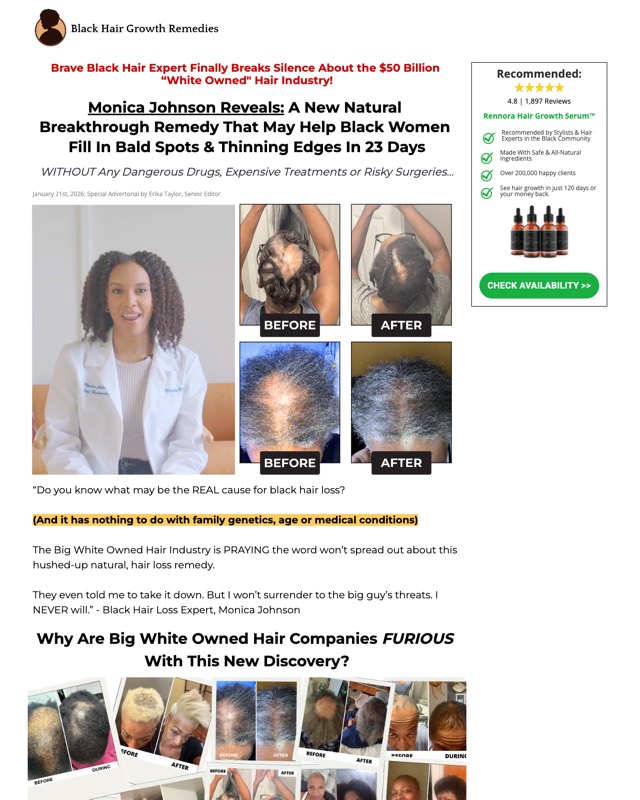
The page wears a publication masthead, "Black Hair Growth Remedies", and a dated "Special Advertorial" line credited to a senior editor, over the headline "Monica Johnson Reveals: A New Natural Breakthrough Remedy That May Help Black Women Fill In Bald Spots & Thinning Edges..."
Proof is visual and early: the expert in a white coat beside a grid of before and after scalp photos. The hook teases the mechanism with a question about the "REAL cause" of hair loss.
The product waits in a right-hand "Recommended" box from the first screen: a star rating, the Rennora Hair Growth Serum, four checkmarked claims and a "Check Availability" button.
Zephta: the doctor-bylined hair explainer

Zephta labels itself "Advertorial" in the top bar, next to "Trending in the US". Under a "Notice Shocking Results" kicker and a doctor byline, a highlighted hook speaks to one reader: "Is your hair feeling thinner, breaking more easily, or just not as full as it used to be?"
The mechanism arrives on the first scroll. Under "This Will Completely Change The Way You See Your Hair Loss." a follicle cross-section sits beside a woman applying the product, and the copy introduces the dermal papilla, the cluster of cells beneath each strand.
The offer is the 2+4 free bundle, "Buy 2, Get 4 Free Today Only!", in the sidebar and again in a sticky bar at the bottom. The sidebar also carries a review panel with a star distribution.
Kiwi: a car care article with a reasons list inside
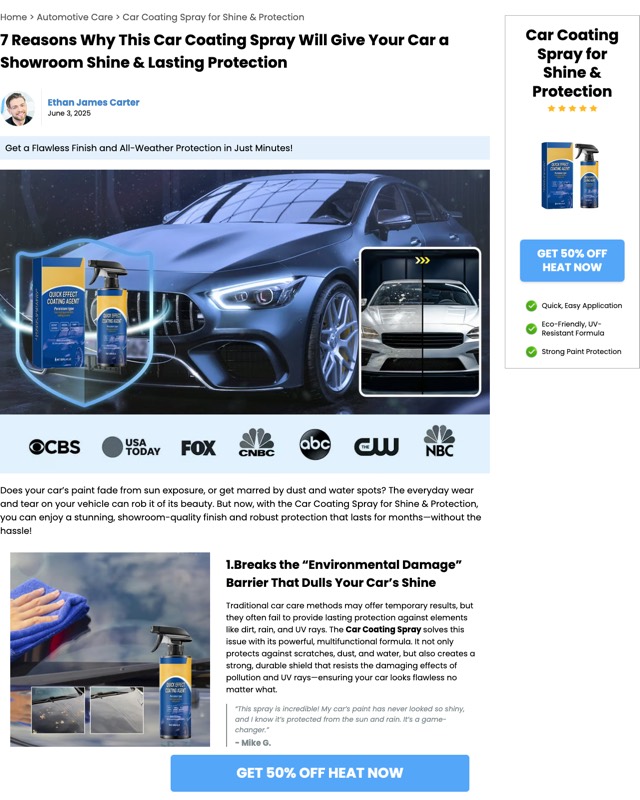
Kiwi's page opens with a breadcrumb (Home, Automotive Care, Car Coating Spray for Shine & Protection), the headline "7 Reasons Why This Car Coating Spray Will Give Your Car a Showroom Shine & Lasting Protection" and an author byline with a photo and date.
Proof is stacked early: a hero of a car with the product and a before and after inset, a strip of TV and news logos (CBS, USA Today, Fox, CNBC and more), and a customer quote under reason one. The first reason names the problem as an "Environmental Damage" barrier that dulls paint.
A sticky sidebar card and a bottom bar carry a discount button. The numbered reasons are a listicle move inside an editorial wrapper.
Pets Are Kids Too: a spine story for dog owners
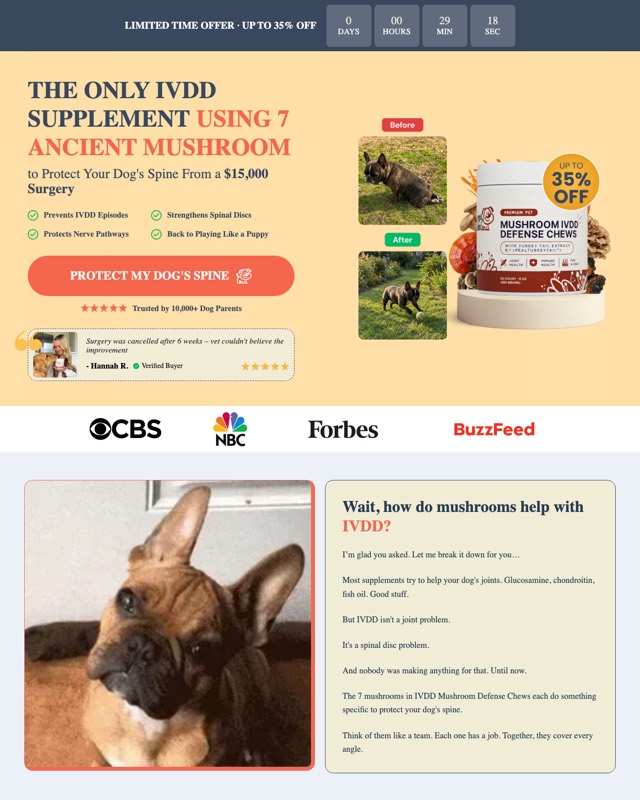
This one opens closer to a sales hero: a countdown offer bar, the headline "The Only IVDD Supplement Using 7 Ancient Mushroom to Protect Your Dog's Spine...", four checkmarked benefits, a "Protect My Dog's Spine" button, a verified-buyer quote and before and after photos of a dog beside the chews.
Under a press strip (CBS, NBC, Forbes, BuzzFeed), the page turns editorial. "Wait, how do mushrooms help with IVDD?" starts a first-person explanation that separates IVDD from joint problems and frames it as a spinal disc problem. That is the one-mechanism beat.
Quasi: the esthetician's top 5 roundup
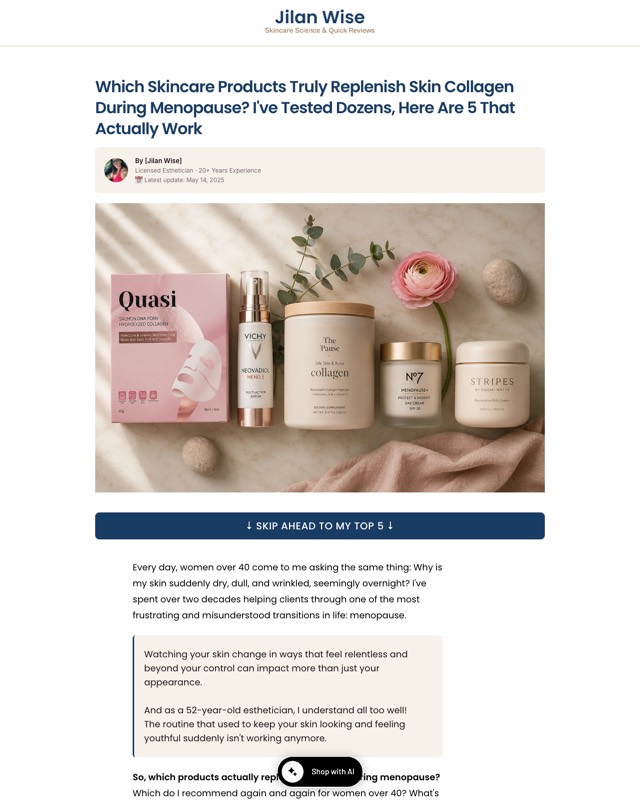
Quasi's advertorial sits under a review-site masthead, "Jilan Wise, Skincare Science & Quick Reviews", with the headline "Which Skincare Products Truly Replenish Skin Collagen During Menopause? I've Tested Dozens, Here Are 5 That Actually Work". The byline presents the author as a licensed esthetician.
The hero photo lines up the Quasi box beside products from other brands, with a "Skip Ahead To My Top 5" button under it. The intro is first person. This is the review-roundup variant: the product earns trust by sitting in a reviewer's ranked list.
How do the 5 advertorials compare side by side?
They share one story engine and differ in wrapper, audience and offer.
| Brand | Category | Story angle (as visible) | Offer or standout element (as visible) |
|---|---|---|---|
| Rennora Beauty | Beauty: hair growth serum | A hair expert "reveals" a natural remedy for bald spots and thinning edges | Sidebar "Recommended" box with "Check Availability" |
| Zephta | Hair growth | Doctor-bylined "Notice Shocking Results" explainer built on the dermal papilla | "Buy 2, Get 4 Free Today Only!" in the sidebar and a sticky bar |
| Kiwi | Car care | "7 Reasons Why This Car Coating Spray..." as a news-style article | TV and news logo strip, sticky discount button |
| Pets Are Kids Too | Pet health: dog spine (IVDD) | A mushroom supplement framed as protection for a dog's spine | Countdown bar, before and after dog photos |
| Quasi | Collagen skincare | An esthetician's menopause collagen roundup, "Here Are 5 That Actually Work" | Product lineup photo, "Skip Ahead To My Top 5" button |
What structure do good advertorials share?
Across five categories, the pages run the same sequence: a publication wrapper, a hook for one reader, a mechanism, proof, then the offer.
- Wrapper: a masthead, breadcrumb or "Advertorial" label, plus a byline and a date. Rennora, Zephta, Kiwi and Quasi all credit a named author or editor.
- Hook for one reader: women with thinning edges, car owners with fading paint, dog owners facing IVDD, women in menopause.
- Mechanism: the "REAL cause" of hair loss, the dermal papilla, the "Environmental Damage" barrier, the spinal disc, collagen in menopause.
- Proof: before and after photos, media logo strips, review panels and customer quotes, placed before or beside the offer.
- Offer: a product box or buy button on the first screen, repeated in a sticky bar on Zephta and Kiwi.
On most of the five, the first screen's words go to the reader and the problem while the product waits in a sidebar.
When should a DTC brand use an advertorial?
Use an advertorial when the buyer needs a new explanation before they will believe a product can help. That is my rule of thumb; the test against the control makes the final call.
- The problem has a history of failed fixes. Thinning hair and a dog's disc problem both come with readers who have tried things before.
- The product needs a mechanism to make sense. Why would a mushroom help a spine? The article has room to answer.
- The traffic is cold and ad-blind. An article earns more reading time than a sales page from people trained to skip ads.
- The buyer is comparing options. A roundup like Quasi's meets them in comparison mode.
When the reader already wants the category and needs reasons to pick yours, a listicle is usually the quicker read. See the listicle landing page examples and the side-by-side in listicle vs advertorial.
Whichever you pick, it gets split-tested against the control. Winners have numbers. Opinions do not ship.
FAQ
How long should an advertorial be?
Long enough to carry the four beats: one reader, one problem, one mechanism, then the product. On Zephta and Pets Are Kids Too the mechanism starts inside the captured top of the page. If a section does not move the reader from problem to mechanism to product, cut it and test the shorter version against the control.
Do advertorials only work for supplements?
No. The five live examples cover a hair growth serum, a hair growth product, a car coating spray, a supplement for dogs and a collagen skincare product. The Kiwi page sells car care with the moves a supplement advertorial uses: a byline, news logos, a named problem and a mechanism. The format needs a problem worth a story.
Should an advertorial show the product above the fold?
Yes, in a supporting role. All five examples put the product or a way to it on the first screen: sidebar boxes on Rennora, Zephta and Kiwi, a hero button on Pets Are Kids Too, and a lineup photo with a "Skip Ahead" button on Quasi. The copy on that screen still belongs to the reader's problem.
What is the mechanism in an advertorial?
The mechanism is the explanation of why the problem happens, and why the product addresses that cause. It turns a claim into something the reader can follow. On the live pages it is the dermal papilla in Zephta's hair loss story, the spinal disc for Pets Are Kids Too, and an "Environmental Damage" barrier for Kiwi's car paint.
How do you test an advertorial?
The same way as any other page: A/B test it against the control, the page your ads send traffic to today, and let the numbers decide. I rank tests by expected revenue impact and roll the winner out. The full loop is in the CRO testing process guide.